
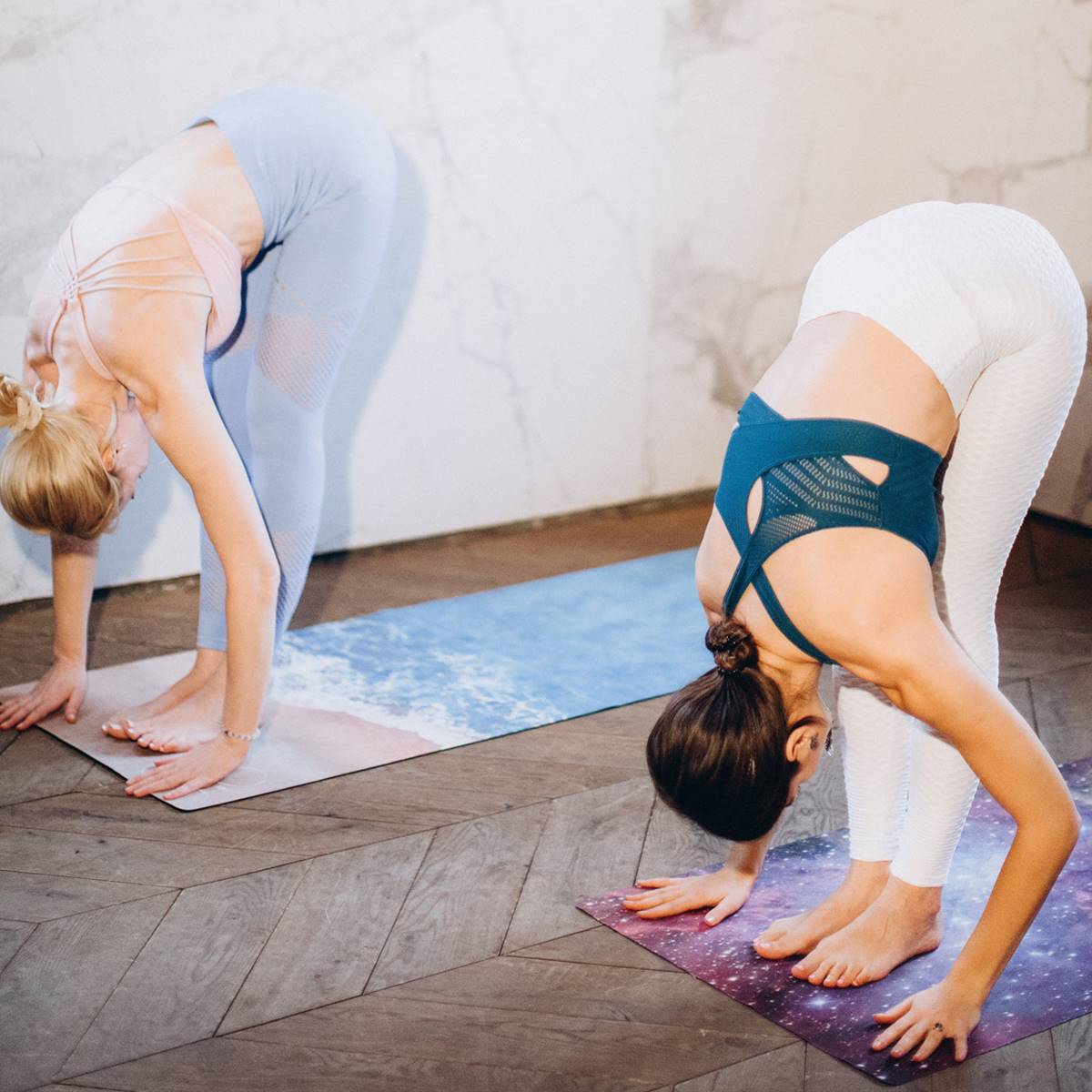
The usual way of performing this posture, trying to reach the ground with your hands, is not the most appropriate when it causes imbalance.

In the practice of yoga, the soil not only sustains us, it is also a source of momentum. Taking advantage of the soil to build the asanas is key to avoid overloading stressed areas.
Maintaining the focus of attention during the practice of yoga can lead you to spontaneously change some movement habits. On the one hand, it allows you to recover or maintain bodily integrity. On the other hand, it helps you to understand something else about the body, movement and its effects on our way of being in the world.
One of the changes to which the attentive and investigative attitude has led me is related to the postures that are usually built from the top down. For example, uttanasana (the pincer) or trikonasana (the triangle). Some time ago I started building them from the bottom up and I’m going to tell you why.
If you want to learn how to practice yoga, check out the Body-Mind’s Yoga Initiation Course.
IF YOU HAVE TROUBLE COMPLETELY FLEXING THE TRUNK WHEN MAKING THE CLAMP…
To perform uttanasana normally, simply raise the arms and flex the trunk forward from the standing position with the intention of bringing the hands closer to the ground.
As long as you have a good ability to adhere to the ground and an even distribution of tension in your connective tissue, performing the lowering gesture is a real pleasure.
You will progressively release the fabric, in a continuous game and adjustment with the force of gravity and the ground. Doing it this way, when the conditions are right, will maintain the tone balance throughout the body.
But, if in the construction of uttanasana you have the feeling that the descent of the trunk is slowed down, it means that an area of the tissue cannot continue with the proposed gesture. He has already given everything he could give. And in the fight against gravity, which would make it continue to spread, it remains hypercontracted to protect itself.
This happens to us when the state of our connective tissue or our ability to root are not one hundred percent.
In this case, you will feel that you are in a position that instead of a sense of balance, gives you a feeling of effort. Training yourself to detect this sensation is a great way to maintain safety in practice.
I have already reached this point; I am descending and the body has stopped the movement.
- Accept the stop of the movement and hold it with the support of the hands in some area of the body.
- Detect which area of tissue is slowing movement. Where is there excess tension?
- Detect which area of tissue is inactive. Where is hyper-relaxed tissue?
- Rehearse, through breathing and micro movement, a redistribution of tension: activate the inactive areas and then observe if that gesture releases the hypercontracted areas.
INCORPORATE YOURSELF WITH THE HELP OF YOUR ARMS
And very important: if the redistribution of tension is not achieved, it is essential to undo the posture using the strength of arms and hands, not only that of the back. Resting on thighs or knees, they will assume the force that the tissue that slows the movement cannot perform. Do not leave the work of doing it to the area that has hypercontracted.
If we haven’t stopped and given ourselves time to loosen the hypercontracted tissue, we have only one solution to keep moving forward: hyperextend another tissue. If we have done so, we will already have two tissue areas that will not be able to participate in the movement to recover verticality.
In this situation it is essential what I tell you above: the use of arms and hands that rest on other areas of the body to undo uttanasana. In case of not using them, injuries during the process of recovering verticality are frequent.
We will have left the posture with an area of hypercontracted tissue and another hyperextended. The distribution of tension and relaxation in the body will not be uniform and we will limit the ability to change state in the tissue.
The recommendation is clear: restore this distribution of tension. And one way to achieve this is to perform uttanasana from the ground.
HOW TO MAKE UTTANASANA (THE CLAMP) FROM THE GROUND
Building this posture from the ground is the way to recover the appropriate conditions of adhesion to the ground and uniformity in the distribution of tension. It also gives us awareness of our solid parts, the bones, and this eliminates the extra tension in the musculature.
When starting from the ground, a force is printed on the movement that ensures safe conditions in which the connective tissue can unfold naturally.
To perform uttanasana from the ground, the first thing we do is rest our hands on the floor, although for this we have to bend our knees. And keeping our hands supported, we will extend our legs until we feel that the movement stops.
- This facilitates balance, eliminating the compensating forces to maintain it.
- It exerts the function of braking against the effect of gravity, which, without the supports, should be performed by the tissue of the back.
- It facilitates the micromovement of the dorsal and lumbar areas, allowing the gradual deployment of connective tissue.
- It allows to accurately graduate the speed and pauses in the construction of the posture, inviting the deep observation of the functioning and state of the body itself.
And remember… You are restoring your ability to adhere to the soil and the even distribution of tension in the tissue. Uttanasana is the way to do it, not your purpose.
WHEN IT IS MOST ADVISABLE TO START FROM THE GROUND
Whenever we are in a moment of physical and emotional change it is highly recommended to move to a type of practice that allows us to verify the changes we are experiencing and find the appropriate way to move in that state.
- In periods of recovery from an injury or illness.
- During pregnancy.
- During childbirth recovery.
- While we are immersed in periods of strong hormonal changes, by natural cycles or by any other cause.
In all this, there is something that is especially valuable to me: learning to support, to push, to expand, to give space, to stop, to observe, to restart, to take into account the parts and the whole, to care.
Keeping all this only in the body environment is too much effort, the contagion to the rest of our ways of expression is natural.
Contemplating how this physical experience is transferred to the emotional, mental, relationship and life strategies realm, is invaluable.