
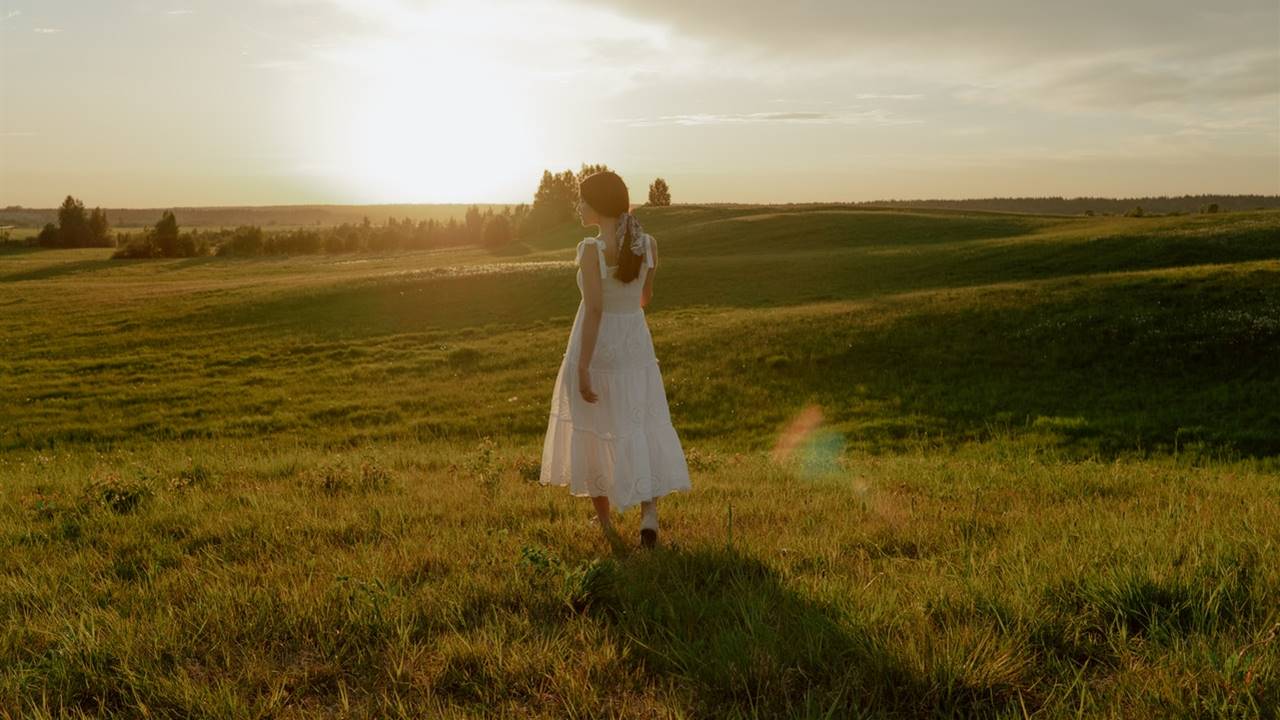
Walking is the great conquest of the human body and one of the most complete and beneficial exercises for health. In addition, delighting in the steps that lead us helps us connect with the present.

Walking is one of the healthiest and cheapest exercises that can be practiced, and doing it the right way can help strengthen the heart, lungs and muscles, as well as generate a feeling of well-being.
Let’s walk through the benefits of walking, such as physical, mental and spiritual experience.
BENEFITS OF WALKING EVERY DAY
When we walk in our body there are changes that have a positive impact on our health. These are the benefits of walking daily.
- It activates breathing, which stimulates the fluidity of the circulatory system and all systems and devices, producing heat. Speeds up the transport of cellular information. It gives life, vivifies our exchange with the environment.
- It lifts the mood and calms the nervous system, when it recovers a rhythm slower than that of thought, the rhythm that touches with the feet on the ground and projects us towards the sky.
- Helps to lose weight. A person of 75 kilos who walks fast for ten minutes each day and for a kilometer spends 550 to 800 calories a day, that is, what a regular meal provides. It is therefore an easy way to control weight.
- It improves cardiovascular fitness, as walking makes the heart beat faster to transport oxygen-rich blood from the lungs to the muscles. Walking regularly increases the efficiency of the heart and lungs.
- It lowers blood pressure and the risk of arteriosclerosis, by reducing the levels of low-density lipoproteins (“bad” cholesterol) and increasing high-density ones (“good” cholesterol).
- Prevents osteoporosis.
- It is one of the most important means of recovery from diseases.
- It generates well-being. Psychologically, walking generates a feeling of well-being and can mitigate or alleviate stress, anxiety and depression by accelerating the production of endorphins, the body’s natural tranquilizer.
- Helps concentration. It makes us more receptive to any information and provides the peace of mind to select, evaluate and elaborate it if necessary.
- It exercises a virtue much needed in our day: patience.
SPIRITUAL BENEFITS OF WALKING
“Walker there is no way, the road is made by walking, by walking the path is made and, when looking back, you see the path that will never be stepped on again. Walker there is no way, but trails in the sea.”
With this famous poem Antonio Machado presents walking as a way of living and the present as the most important moment in our lives. In addition, it confirms the melancholy due to the passage of time, but also its beauty.
Walking is not just any movement but the first that the human being learns while standing and the one that makes it possible to move anywhere.
The one that defines us and makes us equal and different, because there are as many ways of walking as individuals.
It is part of the cultural heritage of West and East, and permeates all fields, in the form of a path walked or to be walked, spiritually or physically. Back to the road
The Tao Te Ching says, “a ten-mile road begins with a step.”
The Tibetan Book of the Dead proposes the initiatory journey from death in this world to life in the afterlife.
The Camino de Santiago, which follows the Milky Way and crosses part of Europe, is a physical path that involves a change of consciousness. Like the Inca Trail, which leads to the top of Machupichu in Peru.
“I got tired, of asking the world why and why, the compass rose has to help me and from now on you are going to see me wandering, between the sky and the sea, wandering. By the mountains, the river, the sun and the sea, which taught me the verb to love.”
Tired of turning things around with thought, Joan Manuel Serrate returns to the road just because, to walk and enjoy what it offers.
WALKING AS THERAPY
But something is happening that makes us lose the north and forget the easiest way to move, precisely now that we can move with all kinds of gadgets anywhere.
Our walks have become therapeutic activities; travel on foot, in connections between means of communication; Our trips are transports in which we are taken.
And a very significant fact: according to the latest research, today people walk more in cities than in rural areas, where it is easier to park cars.
One of the most pressing problems is the rush to come. We do not remember that we are already in the best place, doing what we should do, at the right time.
The journey, the path, walking, lose importance with respect to the place to which we are going. We do not realize that our goal exists in thought, in maps, but it is only a part of the most important moment we live and the only one we really have: the present. Although the ideal illuminates the direction of the route, it is essential to delight in the journey.
WALKING TO IMPROVE MOOD
Walking is one of the most beautiful ways to enjoy the road, to live the time that we have had to live and let the mind expand at ease in a time that belongs to both it and our body. It is the most humane movement that exists.
It puts us in contact with the earth, tunes us with our body, both internally and externally, gives us a binary rhythm, vital to learn any other, because it is the rhythm that speeds up memory.
We can walk in almost all circumstances and places, and reach places that we would never reach otherwise: slopes, cliffs, shortcuts, mountains, summits, forests …
Walking allows us to discover the essence of the places we pass, to observe more precisely the environment.
Even in the big cities, to know them and get to their soul, it is best to buy a good plan, put it in your pocket without looking at it and get lost in the streets, alleys and squares.
Walking is free, safe and effective. It does not require special skills or training, nor does it require machines or instruction manuals. It is recommended for all ages and in all circumstances.
BENEFITS OF WALKING FOR THE BRAIN
According to footprints and skeletons found in West Africa, the first living things began to walk on two legs four million years ago.
Thus, another revolution occurs in the autonomous movement of humans: they do not need to bend their backs to the sides, like reptiles, or bend and stretch it like other mammals.
They make their own a fundamental quality: the legs and arms move in the opposite direction, through the rotary movement of the spine. When the right leg steps forward, the left arm is brought forward, and vice versa. It is a unique movement in the animal world.
The circular movement of the spine allows us to keep our balance, breathe, pick up things, look around, walk … The human being, who until then walked on all fours, must reorganize the movements, find their place and systematize them again.
To coordinate these functions there is an unprecedented growth of the brain. With this neurological development the first stone is laid for the unlimited ability to learn movements. We are able to learn them throughout our lives
When we still do not speak, we begin to walk, in a miracle fruit of imitation that precedes any physical learning, behavior and behavior and that marks us for the rest of life.
In children it is a revolutionary change. Suddenly they can reach unknown places and see from many more points of view than when they crawl. Their movements are directed to a place, they take, they taste, they fall, they learn with astonishing rapidity, and their dynamic development is equated to the cerebral, and soon after they begin to speak.
Walking returns us to the ancestral movement, the one that has not improved or worsened throughout history, the one that does not need words or reasoning but that drives these two by putting the world and its wonders, suddenly, within our reach.
It changes our position and with it the disposition to relate to ourselves and the environment. It is a physical and mental change.
WALKING AS A RITUAL
Since the romantic artists in the nineteenth century, the walk par excellence has been through nature. To return to it was to return to the first house, a ritual to find our roots. But nature in old Europe today is a natural park, in which the lye of human beings and their culture continue to prevail.
In the American continent, new and wild, the writer Henry David Thoreau proposes aminar as a ritual in which we become nature, in a mystical union that was later picked up by the hippie movement.
In Central European countries there is a tradition from medieval times that ritualizes walking.
Young people under thirty left home walking to find places to train in a trade. They made a pilgrimage along the roads for three years and one day, all in the same attire, black corduroy and a bundle of tools and another reserve suit.
They stopped at places where they were allowed to work and learn the trade in exchange for bed and board. They stayed there for a while and returned to the road when they mastered the technique of the place.
They constituted a guild with very clear codes of honor that were transmitted by voice. As important as the trade they learned was the journey they made. Of these, today only carpenters perpetuate this tradition, which can still be seen on the roads of Germany.
In Australia there was the walkabout, a rite of passage from puberty to adulthood in which young Aboriginal people were abandoned in the desert. They wandered for about six months in these places to learn how to survive in a hostile environment. They left with few weapons and when they returned, if at all, they could enter adulthood and marry. Now it is called walkabout to walk without destination.
MEDITATE WHEN WALKING
Let’s walk like a camel, which is the only animal that ruminates when it walks. Let’s make walking an object of study.
A traveler asked a servant of the poet Wordsworth to teach him the master’s study. The butler led him to a room and said, “Here is your library, but the object of study is outside.”
Walking takes us to the beginning, to the simplest, to the present moment: the one in which the intangible becomes miraculous reality.
After having walked for a while, looking forward, towards a point, seeing everything without fixing anything, we will learn to contemplate heaven, earth and their changes. And we will begin meditation, which simply consists of walking where we walk, with our thoughts, body and environment.
To do this, we will observe the breath and its vital impulse and we will feel the organism with the five senses. And we will notice how thoughts flow and change as we walk.
In this flow we will realize that we are not only composed of visible solids or liquids, but that a part of our being belongs to the realm of the invisible, of the ethereal: they are thoughts, emotions, desires, memories, dreams, instincts, impulses and beliefs.
They constitute another energy field, subjective, that is not seen and that occupies a place within us. However, it is as important as the visible and objective energy field: the earth, the sky or the body.
They are the two areas in which we can know, understand and know. When thought and senses flow like our steps, we guess that everything we perceive, everything that exists in the world, is the result of the transformation of the absent into the present, from the invisible into the visible, from the silent into sound, from the tasteless into tasty.
What we contemplate comes from the unknown; What we appreciate is also the fruit of the priceless. Above, below, before, or after the present moment that is fleeting, is the source of all creation, which manifests itself every step of the way.
That which is incomprehensible at another time, other than this one we live. A mystery like existing or being born, which is always there, silent, eternal and generous. It provides the Earth and the Universe with their movement. It is the enigma of which we are part and from which we proceed. And we are getting to know Him in His manifestation as we walk.
Says physician and writer Deepak Chopra, “We are spiritual beings who have human experiences from time to time, and not the other way around.” We are also a manifestation of divinity, in the form of light, heat, muscle mass, bone mass, body, thought, and spirit. It’s who we are, and we appreciate and love it in the simplest movement: walking.
WALKING AS A LIBERATING EXERCISE
Which path is more conducive to walking? Anyone is good, you just need to take the first step and continue for a few minutes.
Let us remember that we live on a planet that moves and rotates on itself. We are passengers and every day we go around the galaxy. The sky changes continuously.
Let’s start by looking at the sky, because he will tell us that walking is an adventure. And if we look at the path we travel step by step, carefully, we will see that it has infinite variations.
If we still feel insecure, we can go where our heart takes us. It doesn’t matter if it’s cross-country, through a park or in a shopping mall crowded with passers-by. Let us ask ourselves the key question, from the heart: will we generate prosperity for ourselves and for those around us? If so, go ahead!
Lewis Carroll said: “If you don’t know where you’re going, any road will do.” Not knowing is an exercise in humility. Whoever does not know, and knows that he does not know, is capable of learning. Nothing makes us as human as learning and adapting to what the body, heaven and earth say. Leaving aimlessly is not wrong, let’s open the senses and let ourselves go.
HELP ALONG THE WAY
They say that once a man reached the end of the road he had walked in his life and, looking at it, observed that in some of its parts there were four footprints and in others only two.
The first traces coincided with the times in which living had been easier, and the second, with the most difficult.
He was puzzled and as he looked ahead, he saw the goddess of the road. And he said: “You promised me that you would accompany me along the way and I see that you only did it when things were going well for me. Why have you deceived me?”
The goddess of the road replied, “I never deceived you; When the road was easy and pleasant, I walked beside you. If you only see a footprint on the road when difficulties and sorrows appear, it is because I carried you on my back.”
There is always a goddess on the path who helps us. Even if we are overwhelmed and the sadness of some loss breaks our hearts, the body always starts and moves us. Heaven does not cease to be there, at all times. Not even the Earth stops spinning.
After walking for a while, looking forward, towards a point, seeing everything without fixing anything, we will learn to contemplate heaven, earth and their changes.
Walking helps us recognize that no matter how bad we feel, there is always a part of us that carries and loves us. That allows you to see the colors of the road and recognize the unlimited sky.
Thoreau says: “The natural remedy for our ills is in proportion, in which night is transformed into day, winter into summer, and thought into experience. Only then will there be air and sunlight in our thoughts.”
If we manage to regain harmony and learn to look, then we will find nature in a pot at home, in a plant or in a street tree.
Let’s not do like that friend who, walking by the sea in a big city, told me: “What I like is nature”.
He was so accustomed to relating nature to fields and forests that he did not notice the depth of the sky or the changing beauty of the waves, nor could he distinguish the pungent smell of saltpeter or the rhythmic cooing and unstoppable water as it caressed the beach.
WALKING TIPS AND GET ALL ITS BENEFITS
The most important slogan is: love your feet, don’t save on shoes. When buying them, try four or five pairs, because each manufacturer has a different last.
The most important thing is that you feel stable inside the shoe, but that you can also bend the sole.
Damping, stability and flexibility must balance each other.
And remember that:
- It is preferable not to walk in full sun. Better in the mornings or afternoons.
- Wear comfortable clothes, which do not squeeze you.
- Walking on a flat surface at first will facilitate concentration.
- Drink water before, during, and after walking.
- Start slowly and then pick up your own pace, be it vigorous or slow.
- When walking, have as much fun as you can.
HOW TO START WALKING
This warm-up exercise provides a light, loose, invigorating, complete and effortless gait.
If we walk calmly but determined, we will distinguish that we place the weight on the right foot and with the hip we move the left foot and leg through the air. And then it happens just the other way around. Each time the hip drags the left foot it relaxes.
We accompany relaxation with thought for a few steps: we feel the weight of the foot, its temperature, if it is loose or stuck to the ankle, what angle it forms with the leg … First, we must walk, and then accompany.
Repeat the process with the other foot. And we compare the two: weight, volume, lightness…
Then we accompany with the thought the left leg when it is dragged by the hip. We turn right and compare them.
We place the hands on both sides of the pelvis and appreciate its movements: up and down, forward and back: and at the sides. We observe the union of iliac crest, coccyx, sacrum and pubis forming a circle (concave or convex), which propels us forward.
Let’s now put the underside of the hand on the back crossing the spine to accompany it. By tensing the left side of the back, we have the weight on the right foot, and vice versa.
To release tension and keep your balance, we project one arm forward, and the other behind.
Finally, we put our hand on our heads, to feel how the footsteps resonate.
It is known that eight out of ten people would improve their health if they walked.