
To prevent stiffness and pain that can affect the back, rollers, shoulders or ankles, it is advisable to perform non-repetitive exercises, which strengthen the muscles and favor balance and harmony in body posture.

More and more people are suffering from joint problems, such as osteoarthritis or arthritis. Part of the responsibility is both the lack of exercise and the practice of high-intensity sports that overload the joints or are based on the repetition of certain movements, such as jumping and running. Of course, the activity is always positive, but it is advisable to protect the joints with specific exercises.
EXERCISES TO PREVENT PAIN AND OSTEOARTHRITIS
Joint pain (mainly in the back, rollers, shoulders and ankles) can limit movement and even hinder daily activities such as walking, bending or climbing stairs. The problem is that joint pain does not warn and manifests itself when there is already an injury or a rheumatic disorder. That is why it is important to be alert to the first symptoms (punctures, stiffness, inflammation …) to prevent them from leading to chronic diseases.
The good news is that osteoarthritis and other problems can be prevented, just start as soon as possible to take care of the joints through gentle exercise routines such as yoga, which favors mobility, flexibility and helps keep the musculoskeletal system in good general condition at any age.
The execution of the postures and practicing conscious breathing on a regular basis (twice a week, at least) are the best allies to avoid this type of ailment, as well as to protect the bones in general, since it strengthens the whole body and corrects the posture. In addition, it calms the mind and improves mood, which favors a better quality of life.
PROMOTES YOUR JOINT HEALTH
Other factors that affect joint health are genetics and age, but again the key is to lead a healthy life. If you want to have healthy joints, integrate exercise and yoga into your life and consider the following goals:
• Maintain an optimal weight, since the joints do not support too heavy loads permanently.
• Eat in a balanced way, with products rich in vitamin C to stimulate the production of collagen, without industrial sugars and reducing the intake of foods with high concentration of purines, since they generate uric acid (red meat, seafood, etc.)
• Drink plenty of water to keep joints lubricated and facilitate mobility.
• Take care of postural hygiene: sitting correctly, bending your knees when lifting weight and avoiding repetitive movements on a joint, are small gestures with great benefits.
Practice the sequence that I propose and you will notice how your joint health improves, your discomfort is relieved and your agility increases.
EXERCISES TO PREVENT JOINT PAIN
STRONGER KNEES
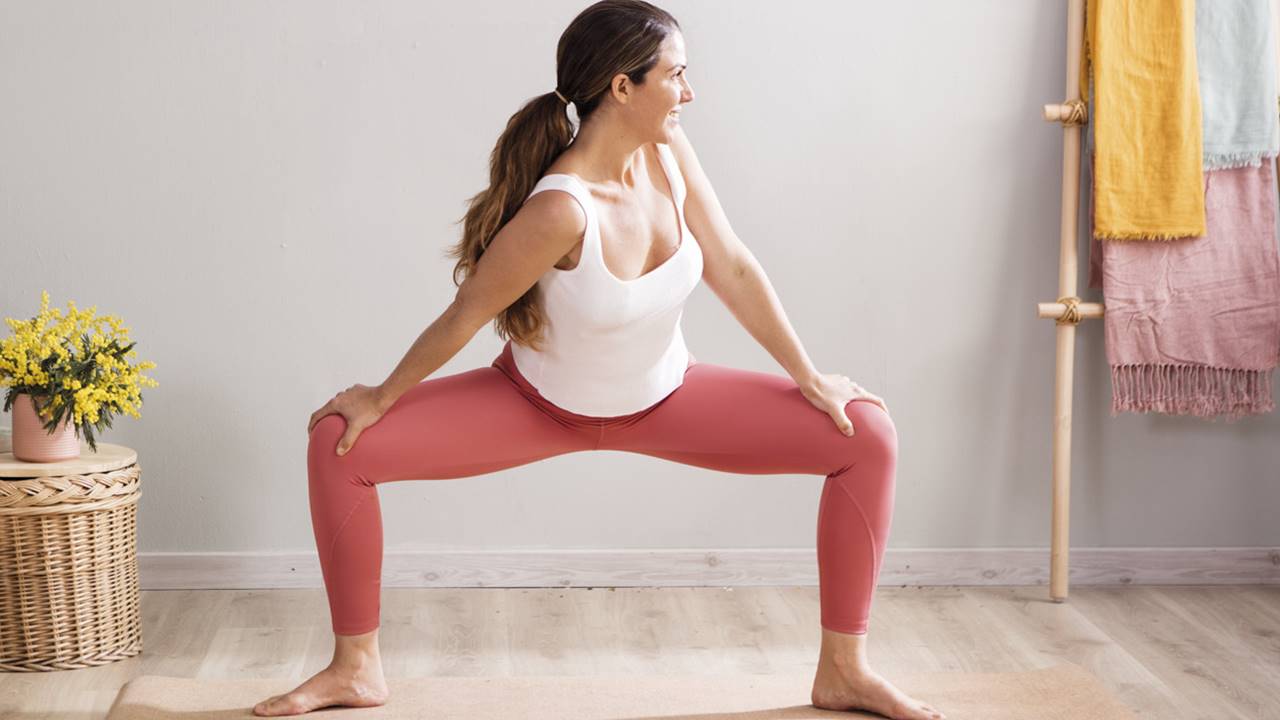
The posture of the goddess strengthens the legs, tones the abdomen and makes the spine more flexible.
- Inhale and spread your legs apart by directing your toes outward.
- Exhale and lower your hips to the floor, bending your knees and keeping your spine upright.
- Place your hands on your thighs and take two breaths connecting with the strength of your legs.
- Turn the trunk to the right in one inhalation and look over your right shoulder. Feel how the torsion frees your vertebrae.
- Hold the pose for five breaths and return to the center in one exhale. Repeat to the other side.
WAKE UP YOUR SPINE
With this exercise you will give mobility to your spine and release tensions.
- Stand in front of the mat with your feet open across your hips.
- Inhale by raising your arms above your head and lengthening your spine.
- Exhale and bring your hands to your thighs. Bend your knees slightly, direct your chin towards your chest and bring your gaze to your feet.
- Breathe dynamically: inhale by sticking your navel in and rounding your back; Exhale by expanding the chest and performing an anteversion movement of the pelvis.
- Take about six full breaths, rest, and repeat the exercise.
ACTIVATE YOUR SHOULDERS
With this posture you will mobilize your shoulders and release emotions.
- Sit on your heels with your back straight and your spine elongated and aligned.
- Inhale, open your arms and interlace your fingers behind your back. Expand your chest upwards.
- Exhale, feel your shoulder blades come together, and try to raise your fists.
- Hold the pose for six breaths and undo it as you exhale. Stay still until the tension in your upper back eases.
UNDO TENSIONS
This posture favors the mobility and flexibility of the hip and offers a great relaxing effect.
- Lie on your back with your legs straight and your arms at your sides.
- Bring the soles of your feet together, move your knees as far away as you can, and bring your heels closer to your pelvis.
- Close your eyes, internalize the opening, release tensions and maintain the posture as long as you need.
- Undo the pose gently by bringing your knees together and hugging them to your chest for a few breaths.
GAIN MOBILITY
If you can’t fully stretch your leg, keep it flexed or help yourself with a belt.
- Lie on your back with your legs straight out and your arms next to your trunk.
- Bring back one leg keeping it straight. The other may be flexed or stretched.
- Breathe a couple of times and take the thumb of your right foot with your hand on the same side.
- Keep your shoulders relaxed and your head on the floor. Breathe 6-8 times and repeat by switching sides.
FLEXIBILIZES THE HIP
At first it may be difficult, but little by little you will notice how the hip gains mobility.
- Sit on the mat with your legs straight out and your spine upright.
- Surround the right tibia with both arms and place the sole of the foot on the left forearm. Try to keep your foot and knee at the same height. The other leg may remain stretched or flexed.
- Inhale and bring the tibia to your chest as much as you can.
- Take about five or six breaths by keeping your spine upright and your tibia next to your chest.
- Undo the pose while exhaling and repeat with the other leg.