
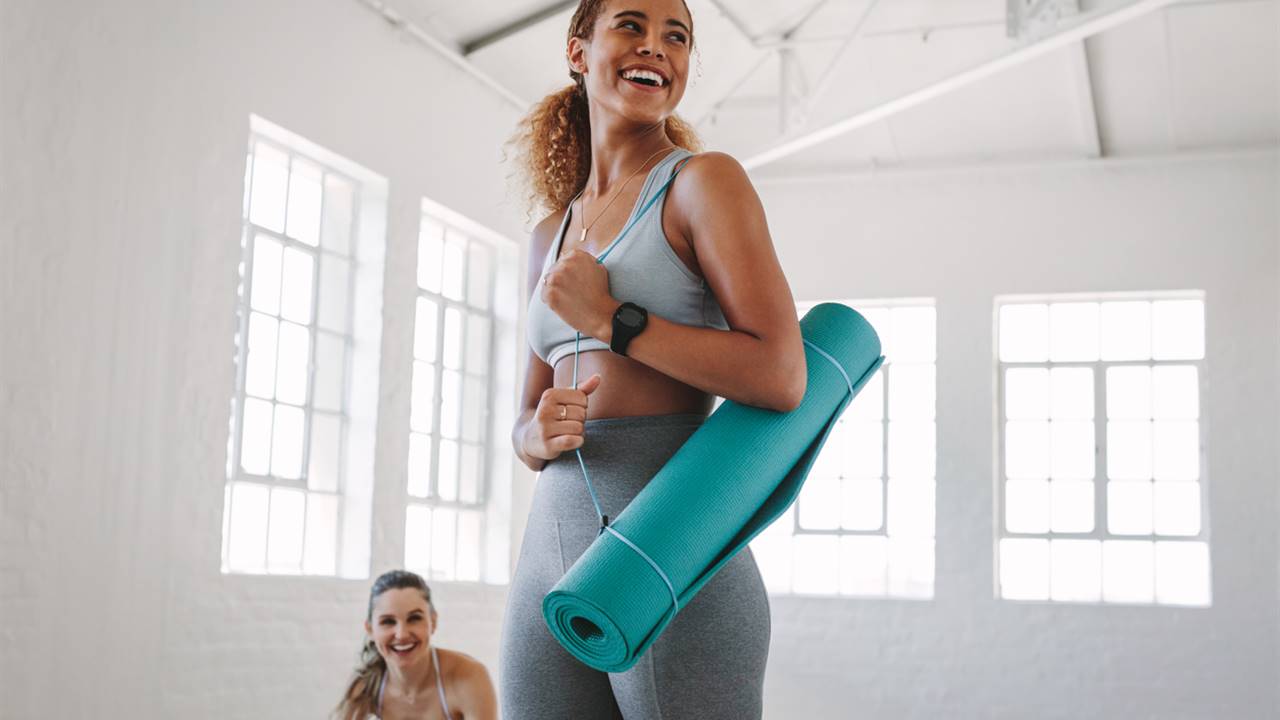
Gyms have a bad reputation: but they are not a space to suffer, nor to exhibit. They are places to work the body and mind with other people. We tell you how to get the most out of it with functional training.

Many people who follow a “natural” lifestyle have certain qualms about gyms. Perhaps they think that they are only frequented by people obsessed with physical appearance, when the truth is that they are attended by many people genuinely interested in taking care of their health. However, gyms can be temples dedicated to physical and mental well-being, if we opt for functional training.
What is functional training? It is a type of training based on exercises that adapt to the natural movements of the human body. The benefits of training is that they allow you to work globally muscles and joints. In addition, they are suitable for people of any physical condition and their health benefits are multiple:
- Improves mobility and posture.
- Improves agility.
- Improves balance.
- Improves cardiovascular health.
- Strengthens the muscles.
- Helps maintain weight.
Nothing prevents using the facilities of a gym to exercise sensibly, without obsessing over physical appearance or making mammoth efforts. Gyms can be temples devoted to physical and mental well-being.
WHO recommends 150 minutes of moderate exercise or 75 minutes of vigorous exercise per week, or a combination of both. Use the necessary breaks in your tasks to go to the gym. We tell you how to take advantage of the time you spend in the gym with a functional training.
BEFORE STARTING A FUNCTIONAL WORKOUT IN THE GYM
When going to the gym it is worth taking into account some tips that experts offer to get the most out of the facilities and services of a gym from the point of view of health:
- It is necessary to interview with the monitor who will guide on the most convenient activities according to the physical constitution and personal interests. He will also tell you how to streamline each exercise.
- It is advisable that the exercise plan combines cardiovascular or aerobic work with muscle toning and stretching.
- In each session you must be clear about the exercises that are going to be performed, their order and their intensity.
- Three weekly sessions of 45 minutes are more effective than one of four hours a week.
- Before the exercise session it is advisable to warm up and at the end a series of stretches.
- If movements are harmonized with breathing, the benefits of the exercises are multiplied.
- Nutrition and rest are two pillars of health that should not be forgotten even if you visit the gym. On the contrary!
FUNCTIONAL TRAINING: EASY EXERCISE TABLE FOR THE GYM
Here we explain a functional exercise routine that you can do in the gym room if you do not want to go to directed classes.
1. KNEE TO ELBOW
Standing, with your legs open at hip distance, raise one knee to touch the elbow opposite the height of the navel.
Find the right rhythm for you. Try doing this exercise for a minute or two, rest for 30 to 60 seconds, and repeat it five times. This exercise should increase your heart and breathing rate.
2. THE IRON
Lying face down, she rests her forearms firmly on the floor, with her elbows aligned vertically with her shoulders. Keep your hips at the same level as your head and the tips of your feet flat on the floor. Hold in this position for 20 to 30 seconds (or longer if possible) and repeat five times.
This exercise will strengthen your abdomen, arms and legs.
3. BACK STRETCH
Lying face down, touch your ears with your fingertips and lift the trunk while your legs remain on the floor. Then, lower your upper body again. Do this exercise 10 to 15 times (or more), rest for 30 to 60 seconds, and repeat five times.
With this exercise you will keep your back muscles in shape.
4. SQUATS
Standing, legs separated at hip distance, toes pointing slightly outward, without taking off heels from the ground, bend your knees until your thighs are almost parallel to the ground. Do not bring your knees forward, think that the tibias should be almost perpendicular to the ground. The posture you acquire at the lowest point would be similar to sitting on a stool. Then stretch your legs. Do this exercise 10 to 15 times (or more), rest for 30 to 60 seconds, and repeat five times.
This exercise strengthens the muscles of the legs and buttocks.
5. RAISE YOUR KNEES TO YOUR SIDES
If in the first exercise you touched a knee with your elbow on the opposite side, now it is about touching the joints on the same side. Standing with your legs slightly apart and your arms open in a cross with your elbows bent, have your knee and elbow touch alternately on the same side. Yes, the result is a kind of comic dance. Try doing this exercise for one or two minutes, rest for 30 to 60 seconds, and perform five sets.
This exercise should increase your heart and breathing rate.
6. SUPERMAN
Get on all fours so that your hands are aligned with your shoulders and your knees with your hips. Bring one arm forward and the opposite leg back, then switch sides. Do this exercise 20 to 30 times (or more), rest for 30 to 60 seconds, and do up to five sets.
With this exercise you strengthen the abdominal muscles, buttocks and back.
7. THE BRIDGE
Lying on your back with your legs slightly apart, bend your knees so that they are on the heels of your feet firmly on the floor. Now lift your hips as much as possible, then slowly lower them down. Do this exercise 10 to 15 times (or more), rest for 30 to 60 seconds, and run five sets.
This exercise strengthens the gluteal muscles.
8. SUPPORTED PUSH-UPS
Stand half a meter in front of an exercise bench, rest your hands on the edge of the seat that will be behind you. Bend your arms while lowering your hips until your thighs are parallel to the floor and then stretch your arms (i.e., go up and down with the outside of your arms). Do this exercise 10 to 15 times (or more), rest for 30 to 60 seconds, and repeat up to five sets. This exercise is designed to strengthen your triceps.
9. OPEN YOUR CHEST
Standing with your legs open at hip level, interlace your fingers behind your back. Extend your arms and stick out your chest. Hold this position for 20 to 30 seconds (or more). In this position the muscles of the chest and shoulders are stretched.
10. POSITION OF THE CHILD
Sitting on your knees on the floor, with your buttocks resting on your heels, let your stomach rest on your thighs and stretch your arms forward. Breathe normally while doing this exercise. Hold this position for 20 to 30 seconds (or more). In this position, the back, shoulders and sides are stretched.
11. SITTING MEDITATION
Sit comfortably on the floor cross-legged (or sit in a chair). Make sure your back is straight. Close your eyes, relax your body and gradually deepen your breathing. Focus on your breathing and try not to be distracted by thoughts or worries. Do not think or, rather, do not follow the thread of your thoughts, let them come and go. Stay in this position for 5 to 10 minutes or more to relax and clear your mind.
12. LEGS AGAINST THE WALL
Bring your hips closer to a wall and let your legs rest stretched out on it. Make sure that the buttocks are in contact with the wall to create a 90º angle. Close your eyes, relax your body and slowly deepen your breathing. Focus on your breathing and try not to be distracted by thoughts or worries. Stay in this position for up to five minutes. This position is comfortable, relaxing and relieves stress.
FUNCTIONAL TRAINING IN THE GYM WITH DIRECTED CLASSES
More and more gyms offer yoga or tai chi classes, Pilates method, massages or aquatic gymnastics, which are classes that respect the natural movement of the body. The number of activities that go on in a good gym is overwhelming. Among the most interesting are the following:
- Pilates method. It promotes flexibility and strengthens the muscles, especially the abdominal, through exercises that force you to concentrate on breathing.
- Aquagym. Exercises in the water to improve overall fitness. Recommended for people who are overweight or have back or knee problems.
- Body balance. It combines Eastern and Western disciplines in order to improve the balance between body systems.
- Stretching. Stretches that improve muscle elasticity and joint mobility.
- Aikido. Non-violent Japanese martial art to harmonize energy.
- Yoga. It unites mind and body through breathing and postures that can be used for therapeutic purposes. It also increases strength and flexibility.
- Tai chi. It consists of a succession of slow movements in harmony with the breath and which are performed in a meditative attitude.